The Wine With a Story: How Charlotte's Most Memorable Hosts Are Reimagining the Dinner Table
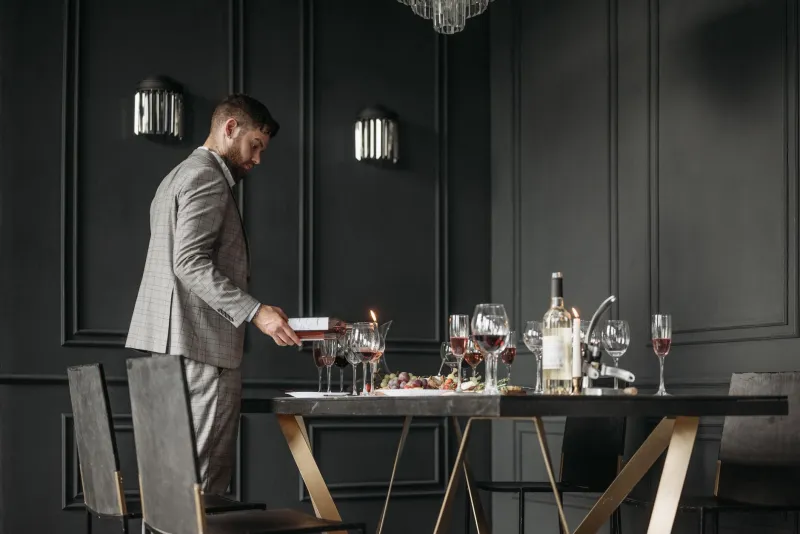
Consider two versions of the same dinner party. In the first, a host presents a well-chosen Barolo alongside the main course—a beautiful wine, correctly paired, introduced with a few competent notes about the producer and the vintage. In the second, the same Barolo arrives with a brief account of the host's first trip to Piedmont: the family-run trattoria where they first encountered the grape, the winemaker who spent forty minutes explaining why Nebbiolo demands patience from both the vine and the drinker, the specific evening light over the Langhe hills that made the experience feel, somehow, permanent.
The wine is identical. The experience is not.
Among Charlotte's most attentive hosts—a community that includes restaurateurs, hospitality professionals, and devoted home entertainers—a quiet but meaningful shift is underway. The curated wine list, that traditional artifact of formal entertaining, is being set aside in favor of something more intimate and considerably more memorable: the curated story.
Why Lists Leave People Cold
The instinct to present guests with a thoughtful wine list is understandable. It signals preparation, communicates respect for the occasion, and offers a kind of structured guidance through the evening's pairings. But lists, by their nature, are impersonal. They describe rather than invite. They inform rather than connect.
"A list tells your guests what to drink," observes one Charlotte-based hospitality consultant who has spent years advising private clients on event design. "A story gives them a reason to care about what they are drinking. Those are fundamentally different experiences, and guests feel the difference even if they cannot always articulate it."
This distinction matters particularly in a cultural moment when authenticity has become the currency of meaningful social exchange. Guests at Charlotte's most sought-after private tables are not arriving hungry for information—they are arriving hoping for connection. Narrative-driven wine service offers a direct path to that connection in a way that even the most meticulously assembled list cannot.
The Architecture of a Wine Story
Not every story is equally suited to the dinner table, and Charlotte's most practiced hosts have developed an intuitive sense for what works. The most effective wine narratives tend to share several qualities: they are brief enough to be absorbed in the time between courses, personal enough to feel genuine rather than rehearsed, and specific enough to create a vivid impression rather than a vague sentiment.
The story need not be the host's own. Regional history, winemaker biography, and the particular circumstances of a vintage all offer rich narrative material. A bottle of dry Riesling from Alsace carries with it centuries of contested borders and dual cultural identity—a story that, told with even modest care, transforms the wine from a beverage into a conversation.
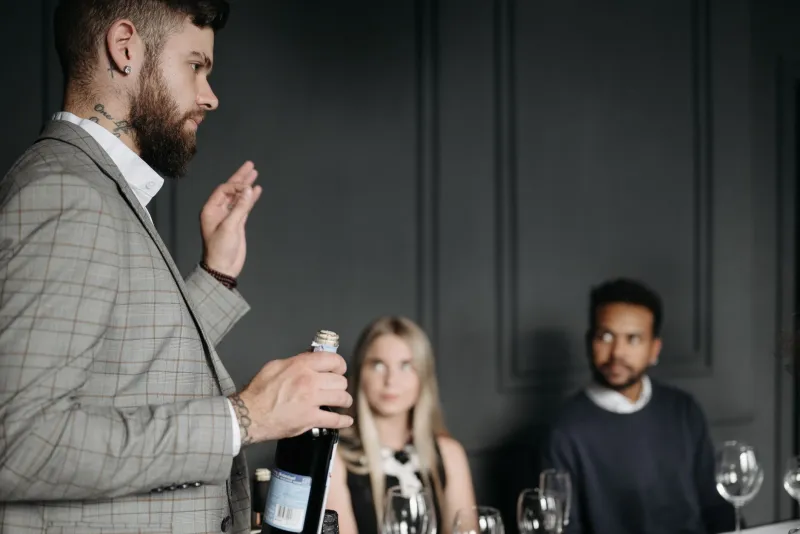
"I keep a small index card for each wine I plan to serve," shares one Charlotte resident known among her social circle for her exceptional dinner parties. "Not tasting notes—I leave those to the professionals. My card has three things: where I first encountered this wine, one fact about the producer or region that genuinely surprised me, and why I chose it for this particular meal and these particular guests. That is all I need."
This deceptively simple framework—personal encounter, meaningful context, intentional selection—provides a template that any host can adapt to their own voice and experience.
Conversations with Charlotte's Hospitality Community
Several of Charlotte's most respected hospitality figures have begun incorporating narrative-driven wine programming into their professional practice, with results that have influenced how they approach entertaining at home as well.
One beverage director at a well-regarded SouthPark dining establishment describes a shift in how staff are trained to present wines by the glass. "We moved away from descriptor-heavy presentations—all that talk of 'hints of blackcurrant and pencil shavings'—toward context-driven introductions. Where did this wine come from? Who made it and why? What was happening in that region during this vintage? Guests engage differently. They ask questions. They remember the wine the next day."
A private chef who regularly designs wine-paired tasting menus for Charlotte clients echoes this perspective with a particular emphasis on intentionality. "The most powerful thing you can do as a host is make a guest feel that a specific bottle was chosen specifically for them, for this evening. A story is how you demonstrate that. It is the evidence of thought."
Practical Guidance for the Home Host
Adopting a narrative approach to wine service requires neither an extensive cellar nor professional training. It requires only curiosity and the willingness to invest modest preparation time before guests arrive.
Begin by selecting wines about which you have something genuine to say—not wines you feel obligated to serve by virtue of price or prestige, but bottles that carry some personal resonance. Perhaps it is the Grüner Veltliner you discovered at a Charlotte wine bar and immediately ordered a case of. Perhaps it is the Côtes du Ventoux a trusted sommelier pressed into your hands with unusual enthusiasm. Perhaps it is simply the first wine you and a close friend agreed was genuinely extraordinary.
Research the producer and region enough to add one layer of context beyond your personal encounter. The Wine Searcher database, producer websites, and the notes of respected critics all offer accessible starting points. Then consider the guests themselves: is there a connection between this wine's story and something meaningful in the room? A shared travel memory, a professional connection, a long-standing conversation?
Finally, resist the temptation to over-present. Two to three sentences, delivered naturally and without performance, are invariably more effective than a prepared monologue. The goal is to open a conversation, not to deliver a lecture.
The Table as Common Ground
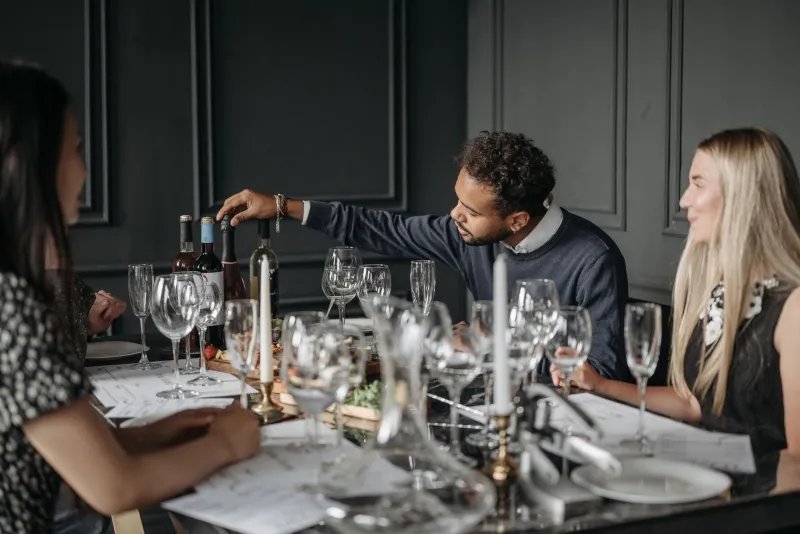
At its most essential, the dinner party exists as a technology for human connection—a structured occasion that gives people permission to be present with one another in a way that ordinary life rarely allows. Wine, in this context, is never merely a beverage. It is a catalyst, a conversation opener, a shared sensory experience that briefly collapses the distance between people.
Charlotte's most gracious hosts understand this intuitively. By choosing story over specification, they are not abandoning the traditions of fine entertaining—they are honoring its deepest purpose. The twine that binds a memorable table together is rarely the quality of the stemware or the precision of the pairing. It is the sense, held by every guest as they drive home, that the evening was assembled with genuine care for them specifically.
A wine with a story is, in the end, an act of hospitality. And hospitality, practiced at its highest level, is always personal.